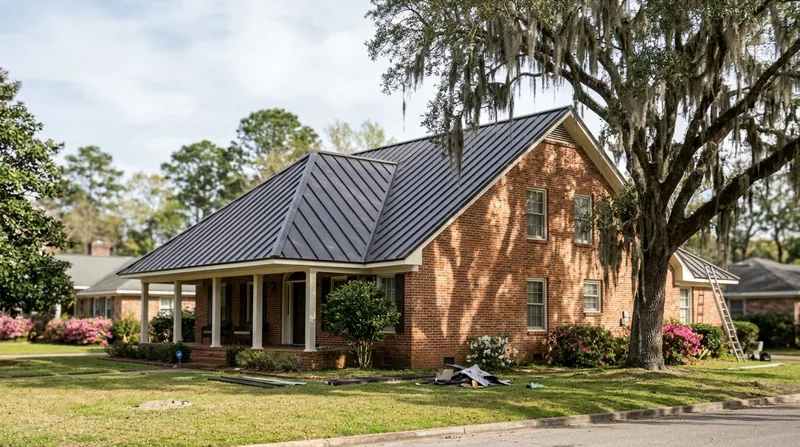




If you own a home along the western shore of Mobile Bay, you already know what your roof fights every year: humid heat, salt air, and afternoon thunderstorms that dump inches of rain in under an hour. Standing Seam Metal Roofing in Mobile is the system we install most for homeowners who want to stop worrying about fasteners backing out of a roof deck that expands and contracts daily. From the steep Victorian gables of Oakleigh Garden District to the low-pitch brick ranches out in Hillcrest and West Mobile, concealed-fastener panels handle this climate better than anything else on the market. Call (251) 319-2788 for a free estimate.
We roll-form panels to the exact length of each slope, seam them mechanically or snap them together, and leave the roof surface free of exposed screws. If you are still comparing systems, start with our metal roof installation page to see how standing seam fits against other profiles.
Why Standing Seam Belongs on So Many Mobile Roofs
Mobile sits on flat, low, sandy-clay ground with a building stock that spans nearly two centuries. That means we work on 19th century Creole cottages in De Tonti Square, 1920s Craftsman bungalows in Midtown and Spring Hill, 1960s brick ranches in Crichton and Toulminville, and 2010s subdivision homes out in Semmes and Saraland. Each of those roofs fails for a different reason, but they all share one enemy: a roof that moves every single day.
- Concealed fasteners eliminate the number one leak source on Gulf Coast metal roofs, which is a backed-out screw and an elongated washer.
- The panels float on clips so the metal expands and contracts with daily heat cycles without stressing the deck or the seams.
- Wind uplift resistance on a mechanically seamed panel far exceeds what a screw-down corrugated roof can hold in hurricane-season gusts.
- A cool reflective finish cuts attic heat gain during the long Mobile summer.
- Panels span low-slope sections on 1950s-70s ranches where shingles never drained well.
For homes near the bay, the salt air accelerates corrosion on cut edges and fasteners, and a proper standing seam install with the right substrate and trim detailing outlasts a shingle roof by decades.
Key info: A homeowner in Spring Hill had a 2005 shingle roof that had been re-nailed twice. After two seasons of storm-driven leaks, we replaced it with a 24-gauge galvalume standing seam system in a dark bronze finish. The panels were roll-formed on site to match the original shallow porch slope, and the roof has not leaked since.
Roofing permits are commonly required for a full replacement in Mobile and the surrounding jurisdictions, and thresholds vary by city and county. Check with the local building department before you sign anything: the City of Mobile publishes permit guidance for residential re-roofs.
How We Install Standing Seam on a Mobile Home
The install sequence matters more than the panel brand. We start by measuring every slope, then we roll-form the panels to length in your driveway so there are no lap joints running down the roof. From there we work through a fixed sequence that keeps water out of the house at every stage.
- We strip the existing roof down to the deck and inspect for soft sheathing, especially on 1960s ranches where old leaks have gone unnoticed.
- We install a high-temp synthetic underlayment rated for the panel temperatures a Gulf Coast roof reaches in July.
- We set the eave trim, valley metal, and any chimney or skylight flashing before a single panel goes down.
- We fasten the concealed clips to the deck on the correct grid for your wind zone.
- We roll-form and lift the panels into place, then mechanically seam or snap-lock each rib.
- We close the ridge, hips, and gable ends, then walk the roof for a final water test at every penetration.
On a typical West Mobile ranch we are on site three to five days, and we do not leave an open roof overnight during hurricane season.
Local example: A 1930s brick Tudor in Ashland Place had three dormers and a steep gable. We broke the standing seam into six runs with custom hip and valley pieces so the panel lines stayed true to the original roofline. The homeowner wanted the historic look preserved without going back to shingles.
If your home is in one of the historic districts or a subdivision with design review, read our standing seam service page for 36606 for how we handle profile and color approvals.
Standing Seam Approaches We Use Across Mobile
Not every roof wants the same panel. We match the seaming method, panel width, and finish to the slope, the wind exposure, and the look of the house.
| Approach | Description | Best for |
|---|---|---|
| Mechanically seamed | Double-locked rib formed with a seaming tool for maximum wind and water resistance | Exposed roofs near the bay and hurricane-season wind zones |
| Snap-lock | Concealed clip system that snaps together without a seaming tool | Standard subdivision roofs in Semmes, Saraland, and Tillmans Corner |
| Narrow-panel profile | 12 to 14 inch panels that read closer to a traditional metal roof line | Historic homes in Oakleigh Garden District and De Tonti Square |
| Wide-panel profile | 16 to 18 inch panels for fewer seams and a cleaner modern look | Large ranch and split-level roofs in Hillcrest and West Mobile |
| Kynar 500 finish | Factory-applied coating with strong fade and salt resistance | Homes on the Eastern Shore in Daphne and Fairhope |
We will tell you which approach fits your slope and exposure after we look at the roof, not before.
Standing Seam Metal Roofing Cost in Mobile: What to Expect
Most standing seam work in Mobile starts at $10 per square foot and climbs from there. That starting figure covers a straightforward tear-off and install on an accessible single-story roof. The number moves based on the panel gauge, the finish, the complexity of the roofline, and how much flashing and trim the job needs.
A steep Victorian gable in Oakleigh Garden District with three dormers and a wraparound porch costs more per square foot than a simple hip roof on a 1970s brick ranch in Crichton, because the cut pieces and seaming time multiply. Homes near the bay often add a corrosion-resistant finish upgrade, and homes in a historic district may need a specific panel width and color that costs more to source.
Get two or three written estimates and compare the panel gauge, the underlayment, and the flashing details, not just the bottom line. Our full pricing overview breaks down what each tier includes so you can compare apples to apples.
Standing Seam Metal Roofing Near Me: How to Choose a Contractor in Mobile
Standing seam is a specialty install, and not every roofer in Mobile has the seaming tools or the panel experience to do it right. A few checks will separate a real standing seam contractor from someone who will sub it out or fake it with exposed fasteners.
- Ask for the license and insurance certificate before work starts, and confirm the coverage is current.
- Get at least two written estimates that list panel gauge, seaming method, underlayment, and flashing by name.
- Ask to see a standing seam roof they installed in Mobile at least three years ago, and go look at it.
- Confirm who pulls the permit, and check whether your historic district or HOA requires design review for panel profile and color.
- Make sure the contract states the panel manufacturer and the finish warranty in writing.
If the contractor cannot answer basic questions about clips, seaming, and wind rating, keep looking. Reach us through the contact page when you are ready to compare.
Key info: In 2023 a homeowner in Theodore hired a low bid for a standing seam roof. The crew installed exposed-fastener panels and called it standing seam. The homeowner found out during the first tropical storm when the screws started backing out. Ask for the seaming method in writing.
Standing Seam Metal Roofing in Mobile: Pricing Guide
| Service | Price | Details |
|---|---|---|
| Standing seam installation, standard roof | Starting at $10/sq ft | Includes tear-off, synthetic underlayment, concealed clips, and mechanically seamed panels on an accessible single-story roof |
| Standing seam installation, complex roofline | Starting at $14/sq ft | Includes dormers, hips, valleys, and steep gables that multiply cut pieces and seaming time on the crew |
| Historic district profile upgrade | Starting at $16/sq ft | Includes narrow-panel profile and approved color for Oakleigh Garden District or De Tonti Square design review |
| Coastal finish upgrade | Add $1 to $2/sq ft | Includes Kynar 500 coating with stronger salt and fade resistance for homes near Mobile Bay and the Eastern Shore |
| Large or multi-slope job | On estimate | Needs an on-site look to price panel runs, crane or lift access, and staging around trees and driveways |
| Estimate | Free | Response within 24h at (251) 319-2788, no obligation to book |
Indicative pricing, the exact cost depends on square footage, finish, and site access. Free personalized estimate within 24h at (251) 319-2788.


